|
Retire Early
Lifestyle
Retirement; like your parents, but way cooler

|
In 1991 Billy and Akaisha Kaderli retired at the age
of 38. Now, into their 4th decade of this
financially independent lifestyle, they invite you
to take advantage of their wisdom and experience. |
|
The
Colorful and Intriguing Streets of Sint Maarten
Billy and Akaisha Kaderli
Currency Converter
The mixed and controversial
history of the Caribbean Islands make for many adventurous myths and
story-telling.
Sint Maarten is no
exception.
The colorful streets, the
foods, the murals, and even names of the bars reflect bygone times of African
Slavery, Indian indentured servants and famous pirates like Blackbeard, Calico
Jack, and Anne Bonny - all of whom operated in this region.
Today we have duty-free
shopping and international cruise ships, with tourists and vacationers all
recognizing the beauty and the economic opportunities available here.
Come take a look below.

Taloula Mango’s / Blue
Bitch Bar
Ok, I didn't name the
place, but this reflects the brazen, in-your-face culture of previous times.
Taloula's is a popular
beachfront restaurant known for its Caribbean vibe, casual dining, and stunning
views of Great Bay Beach. Tourists from the cruise ships love this place for
Taloula's potent rum punch (a nod to the pirates), excellent service and relaxed
atmosphere.

Philipsburg Boardwalk
Today, the
Philipsburg Boardwalk is a bustling 1.5-mile stretch along Great Bay Beach.
There is an assortment of
beach bars,
restaurants, shops, and cultural attractions,
but Sint Maarten and other Caribbean islands were a hotspot for pirate activity
during the Golden Age of Piracy (roughly 1650–1730). It had a strategic
location, numerous coves, and the wealth flowing through the region from
European colonial trade.
Sint Maarten’s role was
more practical than legendary
with its
ports, like Philipsburg, offering pirates a place to trade stolen goods with
corrupt merchants or smugglers.
This was a practice common
in the region where colonial officials often turned a blind eye for profit.

St. Maarten Courthouse
This courthouse, situated on Front Street, is considered one of the most important sites
on the island. The courthouse itself is even featured on the national flag of Sint
Maarten.
Originally built in 1793 as the home of Captain John Philips, the founder
of Philipsburg, over time, it has served as a jail, fire station,
and post office before becoming the courthouse.
It also has a clock and a belfry with 25 bells.

Philipsburg Market Place.
The
Philipsburg Market Place is an open-air market.
Severely damaged in the
Hurricanes Irma and Maria in 2017, the reconstruction finished in the late
summer of 2024.
You can often find fresh fruits, vegetables,
and spices here, as well as souvenirs and crafts.

Thoughtful mural on Sint
Maarten
In the tropics, it's common
to see walls painted as story-telling murals.
In this one, the coat of
arms of Sint Maarten is in the upper left hand side, while themes related to freedom, struggle, hope, and the future of
children fill out the rest of the wall.
Hands breaking free from chains
is a clear
symbol of liberation and the end of oppression that Africans lived under in
earlier times.
The text on the door reads:
"St. Maarten do its part in ensuring
the future for our children. We have to ensure that the problems don't come."
This reinforces the theme of protecting and nurturing the next generation.
These pieces of public art tell a story about Sint
Maarten's history and its aspirations for the future, standing as a powerful visual narrative for both residents and visitors.
The street is part of Philipsburg’s broader cultural
landscape, which includes murals organized by the ColorMeSXM project.

A monument to The Salt Pickers
Before coming to Sint
Maarten, I hadn't realized that salt picking, or salt harvesting, was a cornerstone of Sint
Maarten’s economy and history. It spanned from the 17th century until the
mid-20th century.
The Dutch began settling Sint Maarten in 1631, drawn by the
Great Salt Pond’s natural salt pans, where seawater evaporated under the sun,
leaving salt crystals. Salt was a highly prized commodity - often called
“white gold,” - and was used for preserving food, especially fish, in Europe and the
Americas. The Dutch West India Company oversaw early salt mining operations.
By 1850, Sint Maarten
exported up to 400 boatloads per year making the island a
significant player in the global salt trade. This trade connected Europe, North
America, and the Baltic Sea region, where salt was critical for fish
preservation.

A closer look at the
monument
Salt picking was labor-intensive, involving shoveling and
scraping salt crystals from the pond’s surface.
The workforce included free
people and enslaved individuals from both the Dutch and French
sides of the island. Women were notably prominent as salt
pickers, while men often fished. Enslaved workers, including women, children,
and seniors, faced grueling conditions, yet the trade fostered a sense of
community and identity.
The salt industry outlasted other economic ventures like sugar
and cotton but declined after the 1920s due to global competition and changing
economic priorities.
By 1949, the Dutch ceased salt production on the island,
and tourism later replaced salt as the primary economic driver.

Back Street
In some ways, life was simple "back then."
Sint Maarten has a Front Street, a Back
Street and an Old Street.
Beginning with Philipsburg Boardwalk, Front
Street is next, then Back Street.
Old Street runs perpendicular to these, where
various local shops and cafes stand, offering tourists refreshments or a meal.

African Market
The African Market in Philipsburg, Sint
Maarten, is a shopping destination offering a unique selection of handmade
African-inspired goods.
It's in the heart of Philipsburg, the capital of the Dutch side of Sint
Maarten, and this market specializes in authentic artwork, jewelry, and clothing
directly sourced from Africa.
You can find handcrafted artwork such as
paintings and carvings, jewelry like beaded necklaces and earrings, and
clothing inspired by African designs.
It's not a big store, as you can see, and
they are used to bargaining, so don’t hesitate to negotiate for better
deals.
Bring cash (U.S. dollars are widely accepted) as not all vendors
on the island take credit cards
Back "in the day" both
Dutch and French powers relied heavily on enslaved Africans to work on sugar,
cotton, and salt plantations.
The British Slavery
Abolition Act of 1833 didn’t directly apply to Dutch or French territories, but
it influenced the region.
The French abolished
slavery in 1848, freeing enslaved people on Saint Martin. The Dutch lagged
behind, only abolishing slavery in Sint Maarten in 1863, with a 10-year
“transition” period that forced formerly enslaved people to continue working for
their former enslavers until 1873.

Methodist Church in Philipsburg, Sint Maarten.
The Methodist Church in Philipsburg was
founded in 1851, making it one of the oldest religious institutions on Sint
Maarten.
Established by John Hodge, an enslaved
African from Anguilla, introduced Methodism to the island in 1817. His efforts laid the groundwork
for the church’s formation, initially through services held in homes.
The current stone structure, built in 1851,
was reconstructed in 1976 and has since been a central place of worship.
The church is located on Front Street near key
landmarks like the Philipsburg Courthouse and the Salt Pickers Monument.
Early members, including John Hodge, are buried
here in the cemetery.

A non-working but pretty clock
This clock, as pretty as it
is, isn't giving the correct time.
However, it's fashioned in
the European style and adds character to the street.

A local woman and Akaisha
During our stay on the island there were
several celebrations and costume-wearing events.
This young woman said she wanted to be a
"Jewish Princess" so in her mind, she dressed as one for the parade.
Personally, I look as though I stuck my
finger in a light socket, with my hair so wild and without shape, but hey, it's
the tropics!
Maybe I'm in costume too!

The quiet road leading to the Courthouse
With the shaped and cleaned palm trees, this
road gives a stately look to approaching the Courthouse.
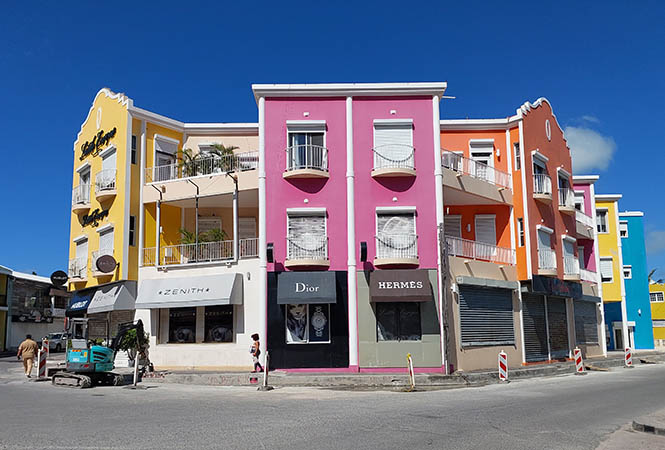
The pastel-colored buildings of "Little
Europe"
A prime shopping area, you can see signs for luxury brands like "Dior," "Hermes," and "Zenith."
This small shopping area is located on Front Street in Philipsburg, which is famous for its duty-free
shopping.
As an aside, during the Pirate's hey day,
Sint Maarten's reputation for lawlessness attracted a mix of settlers, including
former pirates turned “legitimate” traders.
Smuggling thrived well into the 18th century,
as Sint Maarten’s duty-free status - which is still a draw today - made it a hub
for illicit trade.

Greenhouse Restaurant
The Greenhouse Restaurant is
located on Front Street, in the heart of the city.
It has a casual yet vibrant atmosphere, offering a mix of
Caribbean, American, and
international cuisine.
There is a happy hour and live music at night.

Robbie’s Lottery
Robbie’s Lottery is a well-known lottery
operator in Sint Maarten
Gambling is a notable part of the island’s
tourist-driven nightlife, reflecting its reputation as a Caribbean "Sin City."
Sint Maarten has 13 casinos overall, with
several concentrated in Philipsburg, the capital. The gambling scene here caters
primarily to tourists, especially cruise ship passengers.
Gambling in Sint Maarten is technically
unregulated, operating in a legal gray area. There’s no formal gambling
legislation.
Small outlets such as Robbie's often serve as
social hubs where locals gather, play, and chat, while also attracting tourists
with the promise of quick wins.

Plaza Oliva
Plaza Oliva is located on Back Street which
is known for affordable fashion, electronics, and everyday items. You'll find
a mix of retail stores, boutiques, or local vendors.
Front Street has more luxury brands.
This Plaza is a 10-15 minute walk from the cruise port.

Old Street
Old Street is a short, "cobblestone" alley running off
Front Street, and stretches
just one city block.
The street is lined with buildings that date back to this period,
originally homes that have been converted into shops, galleries, and cafés.
These structures feature traditional Caribbean and colonial architecture, with
colorful facades—often painted in bright hues like yellow, pink, and blue—adding
to the street’s vibrant, picture-perfect appeal.
Philipsburg, founded in 1733 by John Philips, was established between Great Bay
and the Great Salt Pond to facilitate the salt trade. The town is a narrow
strip, only four streets deep and one mile long, with Front Street, Back Street,
and the Boardwalk being the primary arteries. Old Street, as one of the oldest
streets in Philipsburg, connects these areas and offers a glimpse into the
town’s colonial history.

Another colorful mural
There is a guided mural tour in Sint Maarten,
where you can see this mural in person.
Tropical flowers, a local woman, a cruise
ship, palm trees and the sea.
Another mural organized by the ColorMeSXM project.

Diamonds International
Diamonds International is part of a larger chain that began in St. Thomas over 30 years ago and has
since expanded to over 100 locations across the
Caribbean,
Mexico,
Central
America, and Alaska, with its headquarters in New York City.
This one is located on Front street which is lined with
duty-free stores.
It is one of the Caribbean’s most recommended
jewelers offering a wide selection of
luxury jewelry.
When you complete a
purchase, DI has been known to offer champagne to celebrate.
Bargaining is part of the Caribbean culture,
and you can
haggle for better deals, especially on larger purchases like engagement rings or
watches.

Diamonds Be Dazzled
This shop
focuses on a curated selection of jewelry, including diamonds, gemstones and locally inspired
pieces like Caribbean charm bracelets or larimar jewelry, which are common in
Sint Maarten.
If you’re seeking a unique piece with a local flair, visit early in the day to
chat with staff and explore their offerings.
Again, bargaining is common in
Philipsburg, so don’t hesitate to negotiate.

Billy and Akaisha in front of the
Courthouse
The heart of downtown is very clean.
You won't see trash lying about nor will you
encounter graffiti.
It's a respectful sort of place with friendly
people showing Northern European manners.

Local tailor
When you travel as much as we do, from time
to time, there is bound to be a need for a repair.
Billy's bag zipper went pffffffttt! and this
local tailor from Jamaica charged him $10USD to fix his bag.
We paid him cash.

Google Fashion?
Fashion retail is common on Sint Maarten but
this storefront is likely using the "Google" branding without authorization.
It's an obvious business move to leverage the
name for visibility.
This shop sells casual clothing and has many
sales signs.
Sint Maarten’s duty-free status means no
taxes are added, so some items can be up to 50% cheaper than in other countries.

Akaisha purchasing bottled drinking water
The sun and its heat are exceptional on these
Caribbean islands.
One must hydrate themselves often or you
could find yourself rather faint.
I am purchasing some bottled water here at a
local store for $1USD.

A poster advertising the famous Maho Beach
Maho Beach, located on the
Dutch side of St. Maarten, is a famous beach known for its proximity to the
Princess Juliana International Airport, where planes land and take off just a
few meters above the beach
This unique feature makes
it a popular spot for tourists and aviation enthusiasts.
The beach itself is small
and sometimes crowded, with waves that can be high.
We
saw the real deal here watching the planes land when we were catching our
flight to Nevis, West
Indies.
We certainly recommend this
experience.

Billy and a sweet young girl
Billy's here at the grocery store speaking
with a local.
The islanders are very friendly.

Caribbean Rotis
Here's an interesting story
for you.
Following the
abolition of slavery on the island, plantation owners across the Caribbean faced
labor shortages as freed Africans often refused low-wage plantation work.
Indian indentured labor in
the Caribbean emerged as a replacement for that enslaved labor, and they they
worked on sugar plantations and elsewhere under five-year contracts.
These contracts typically
promised wages, housing, and a return passage after five years, but conditions
were often harsh.
There were long hours,
inadequate food, and limited medical care.
Many laborers were misled
about the work or destination, and the system has been criticized as a “new form
of slavery” due to the exploitative nature of these indentured servants.
Well, the Indians brought
with them the delicious comfort food called Roti.
It's now a very popular
dish made as a a flatbread wrap (like a burrito for easy eating) from a simple
dough of flour, water, salt, and sometimes oil or baking powder.
The dough is rolled out
into a thin, round shape, cooked on a flat griddle (tawa), and often lightly
brushed with oil or butter for a soft, slightly flaky texture.
It's a portable meal with
fillings like curry or stew, reflecting the Indian influence but adapted with
local Caribbean flavors.
There are chicken curry
rotis, goat rotis, beef, shrimp and vegetable rotis.
It's a balance of savory
and spicy, and Caribbean roti fillings often feature a mix of Indian spices with
local additions like thyme, allspice, and fiery Scotch bonnet peppers. Some
places might add a touch of sweetness with ingredients like coconut milk.
Roti in Sint Maarten reflects the island’s
multicultural heritage, blending Indian, African, and Caribbean influences.
Have you ever had one?



Retire
Early Lifestyle appeals to a different
kind of person – the person who prizes their
independence, values their time, and who doesn’t
want to mindlessly follow the crowd.
HOME
Book Store
Retire Early Lifestyle Blog
About Billy & Akaisha
Kaderli
Press
Contact
20 Questions
Preferred
Links
Retirement
Country Info
Retiree
Interviews
Commentary
REL
Videos
|


